
Driveways & paving
Monoblock, Resin or Slabs: Choosing a Driveway in the West of Scotland
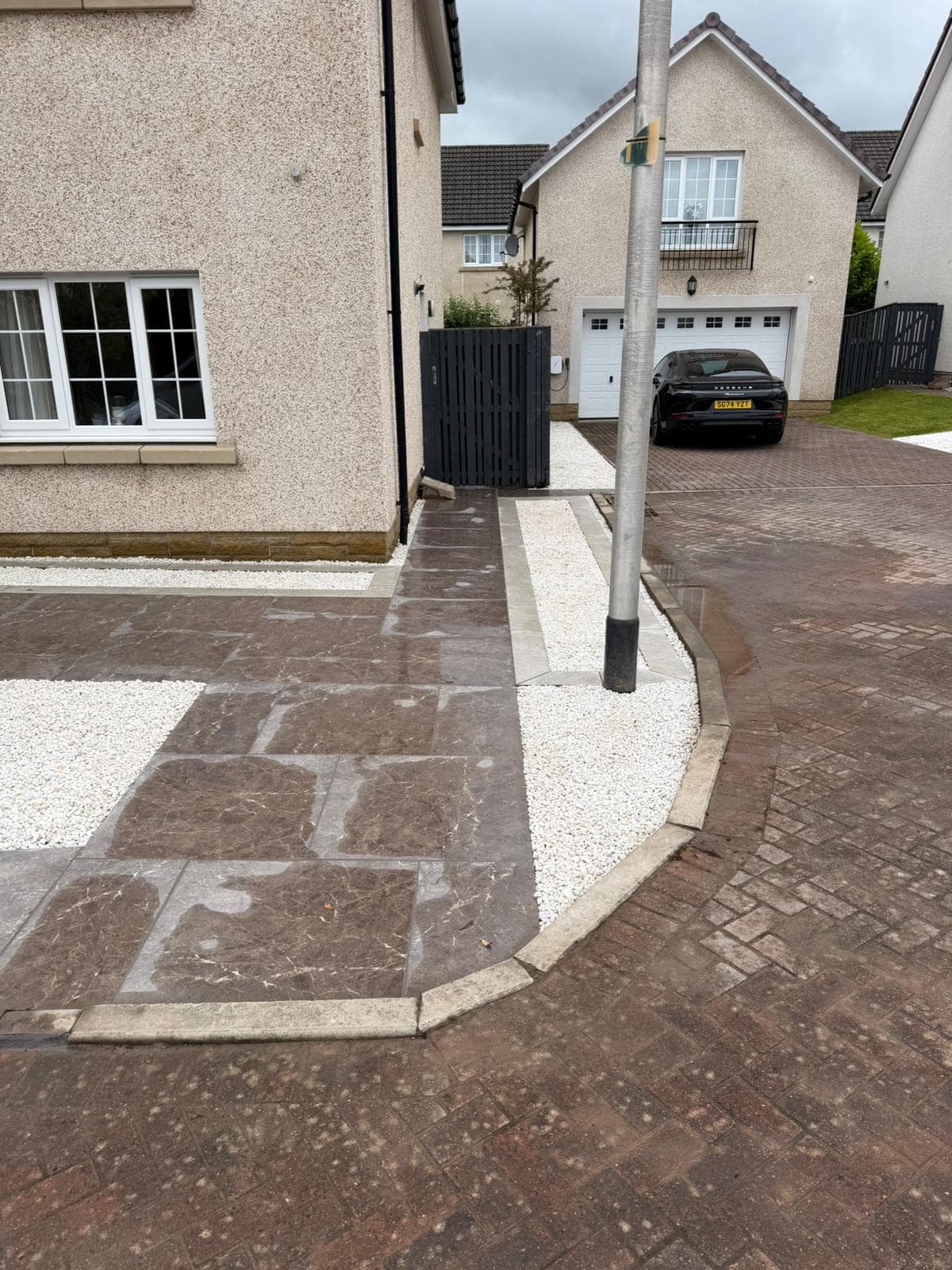
A driveway is the largest single surface most houses have, it carries the heaviest loads, and it takes the full force of the weather. It is also the element where cutting corners on the build-up is easiest to hide and quickest to show. Choosing the surface is the fun part; what goes underneath is what you are actually buying.
The four surfaces, honestly compared
Monoblock is the default for good reasons. It is hard-wearing, individual blocks can be lifted and replaced if something is spilled or a service needs accessed, and there is a huge range of styles. Its weaknesses are weeds and sand loss in the joints over time, and sinking wherever the sub-base was inadequate. Both are maintenance issues rather than failures, and both are avoidable.
Resin bound gives a seamless finish with no joints to weed, and it is permeable, which matters for drainage rules. It is less forgiving of a poor base, since the resin layer is thin and simply follows whatever it is laid on. It also needs a properly cured base course and dry conditions to install, which is worth knowing when scheduling work here.
Slabs and natural stone suit a driveway that needs to match the house or a period property. They want thicker units and a full mortar bed for vehicle loading, so it is not simply a patio scaled up. Gravel is the cheapest and drains freely, but it migrates, needs edging and topping up, and is awkward on any slope.
“Done my grouting for my driveway and an excellent job was done! Would recommend his work to anyone! Thanks again team.”
What actually decides how long it lasts
- Excavation depth. A driveway needs materially more depth than a patio because it carries vehicle weight, not furniture.
- A compacted sub-base laid in layers. Compacting 150mm in one pass does not achieve the same result as two 75mm layers, and the difference shows up as ruts within a few years.
- Falls and drainage. Water has to go somewhere deliberate. Surface water must not be discharged onto the public road, and a permeable surface or a soakaway is usually how that is handled.
- Edge restraint. Every driveway pushes outward under load. Without a properly haunched edge the whole surface creeps and the joints open up.
The planning point people miss
Paving over a front garden with an impermeable surface can require planning permission unless the water is directed to a permeable area within the property. Building a driveway that drains to a soakaway, or using a permeable surface, generally keeps you clear of that. If you also need a dropped kerb to get across the pavement, that is a separate application to the council and it is worth starting early because it can take a while.
Driveways, paths and front garden landscaping are usually worth doing together, since the excavation, edging and drainage overlap and doing them in one visit costs less than two. Work is carried out across Glasgow, Paisley, Renfrew and the surrounding towns, and every job starts with a look at the site.
Related services
Areas this applies to
Get a free quote
Tell us where you are and what the garden needs. Quotes are given after seeing the space, so the price reflects the actual job rather than a guess.
- Call
- 07766 636189
- Message on WhatsApp
- Opening hours
- Monday to Sunday, 8:00am – 4:00pm